People use "sanding" and "polishing" like they're interchangeable. They're not — they're two different tools that do two different jobs, and mixing them up is how paint gets ruined.
Here's the short version: sanding levels, polishing refines. Everything else follows from that.
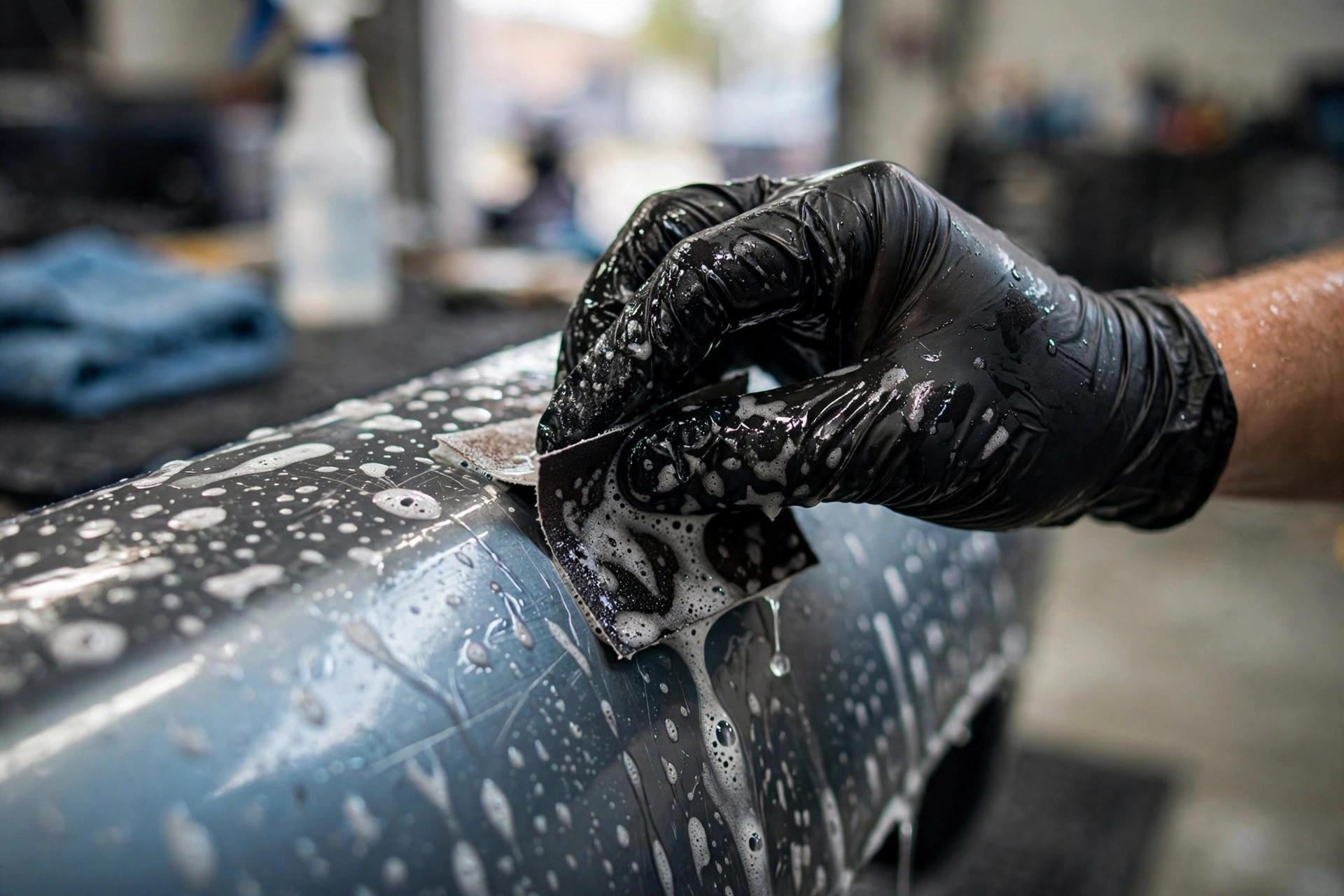
What Wet-Sanding Does
Wet-sanding uses ultra-fine abrasive paper — usually 1500 to 3000 grit — with water as lubrication to physically level the surface of the clear coat. It's the heavy artillery, reserved for problems polishing alone can't fix:
- Orange peel — that factory-textured look in the clear
- Deep scratches that a polisher can't reach
- Paint runs and sags from a respray
- Heavy oxidation that's gone past what a compound can cut
Sanding removes material fast — and it leaves its own fine scratches behind. That's expected. Sanding is never the last step; it's always followed by compounding and polishing to refine what the sandpaper leveled.
What Polishing Does
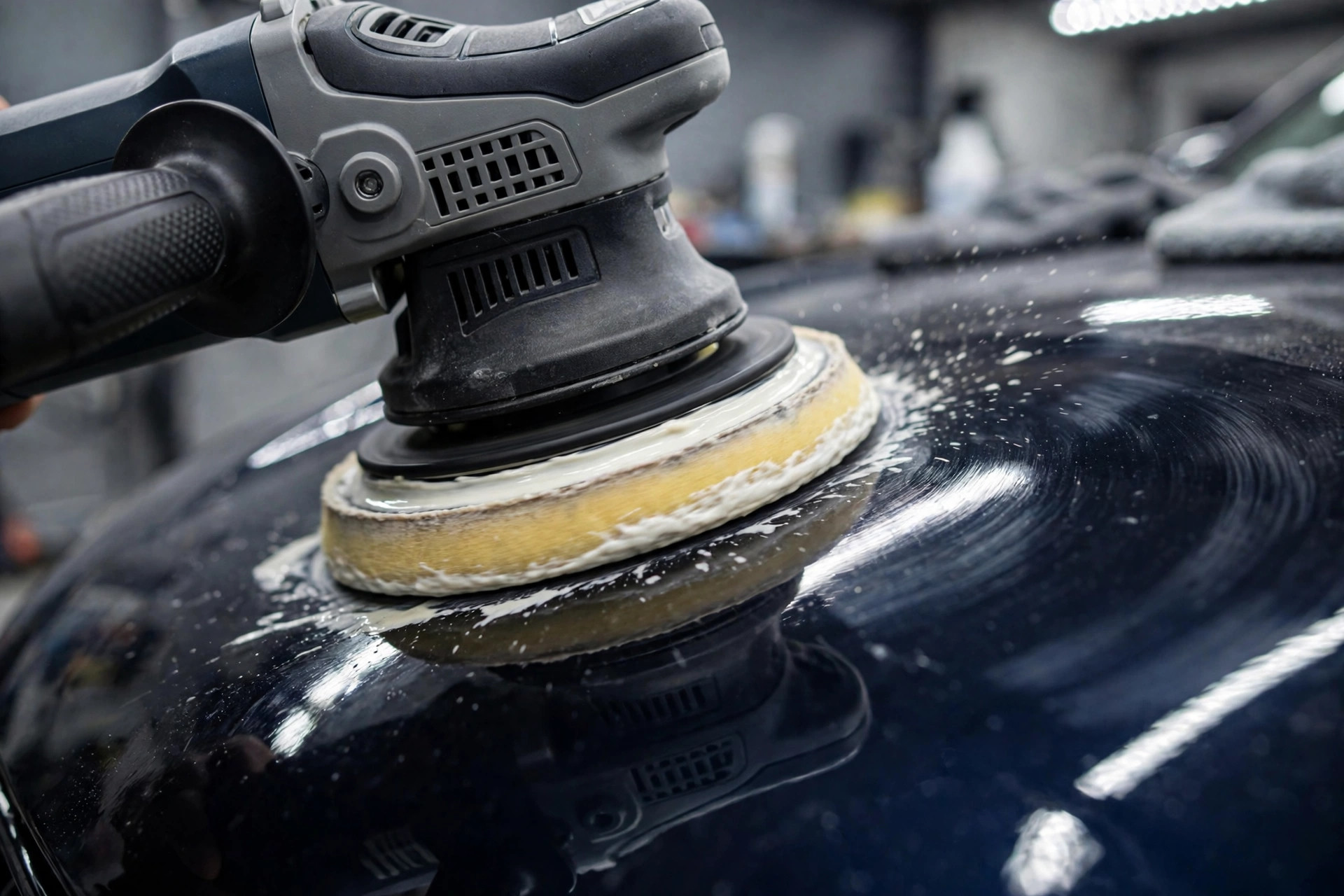
Polishing uses abrasive liquids (compounds and polishes) on a machine pad to refine the surface — removing swirls, haze, light scratches, and water spots, and bringing out gloss. It removes far less material than sanding, and it's the finishing step in every correction.
Most paint correction jobs never involve sandpaper at all. A 1-step or 2-step machine polish handles the vast majority of real-world defects.
Why Sanding Is the Last Resort
Here's the part that matters: your clear coat is roughly 2 mils thick — about half the thickness of a human hair. Every pass of sandpaper, every compounding step, spends a little of it. And unlike money, clear coat doesn't grow back.
Sand through the clear and you're into the color coat — that's a burn-through, and the only fix is a trip to the body shop for a respray. That's why sanding is strictly professional territory: it takes paint-depth readings, experience, and judgment to know how far is too far.
A good detailer sands only when the defect demands it, measures constantly, and stops with margin to spare. Anyone who reaches for sandpaper first is someone you should walk away from.
How a Pro Decides Which Tool to Reach For
The rule is always least aggressive method first. A good detailer starts with a test spot: try polishing and see what it does. If the defect levels out, sandpaper never enters the picture. Sanding only comes out when polishing proves it can't reach the problem.
Before any of that, a pro takes paint-depth readings across the panel. Those numbers tell you how much clear you're working with and how much you can safely spend. Thick factory clear on a flat hood? More room to work. Thin readings on an edge or a previously-repainted panel? Extreme caution — or a recommendation to leave it alone.
That judgment — test, measure, then decide — is the real difference between a professional and someone with a sander and confidence.
Quick tip: if a shop quotes you a correction and never mentions measuring your paint, ask. The gauge reading takes thirty seconds and it's the difference between a safe correction and a gamble with your clear coat.
The Bottom Line
Sanding levels the big stuff, polishing refines the rest — and both spend a finite resource. The right detailer knows which tool the job needs and, just as importantly, when to put the sandpaper down.
Message us today to have your paint evaluated by someone who measures before they cut.
Vinnie's Auto Detailing and Ceramic Coating — Brookville, PA. ⭐100% Five Star Reviews⭐ | ☎️ 724-689-5482