Run your hand across your car's paint right after a wash. Feel that gritty, sandpaper texture? That's not dirt — the wash already removed the dirt. What you're feeling is contamination bonded to the paint, and a big part of it is iron.
Every time you drive, your brakes shed microscopic iron particles. So do the cars around you, railroad tracks, industrial areas, and construction zones. These tiny hot metal shavings land on your paint and embed themselves in the clear coat, where they start to rust in place. On a white car you'll sometimes see them as tiny orange or brown dots. On darker colors they're invisible — but they're there.
Why Washing and Clay Aren't Enough
Soap removes loose dirt. It does nothing to iron particles physically embedded in the clear coat — they're stuck, not sitting on top.
A clay bar can pull them out, and claying is a necessary step. But here's the problem with claying over heavy iron contamination: the clay grabs those sharp iron particles and drags them across your paint to get them out. Dragging metal across clear coat is exactly how you create micro-marring. It's like pulling a splinter out sideways.
The right move is to dissolve the iron chemically first, then clay what's left. That's what iron decontamination does.
The Purple Bleeding Reaction (Yes, It's Supposed to Do That)
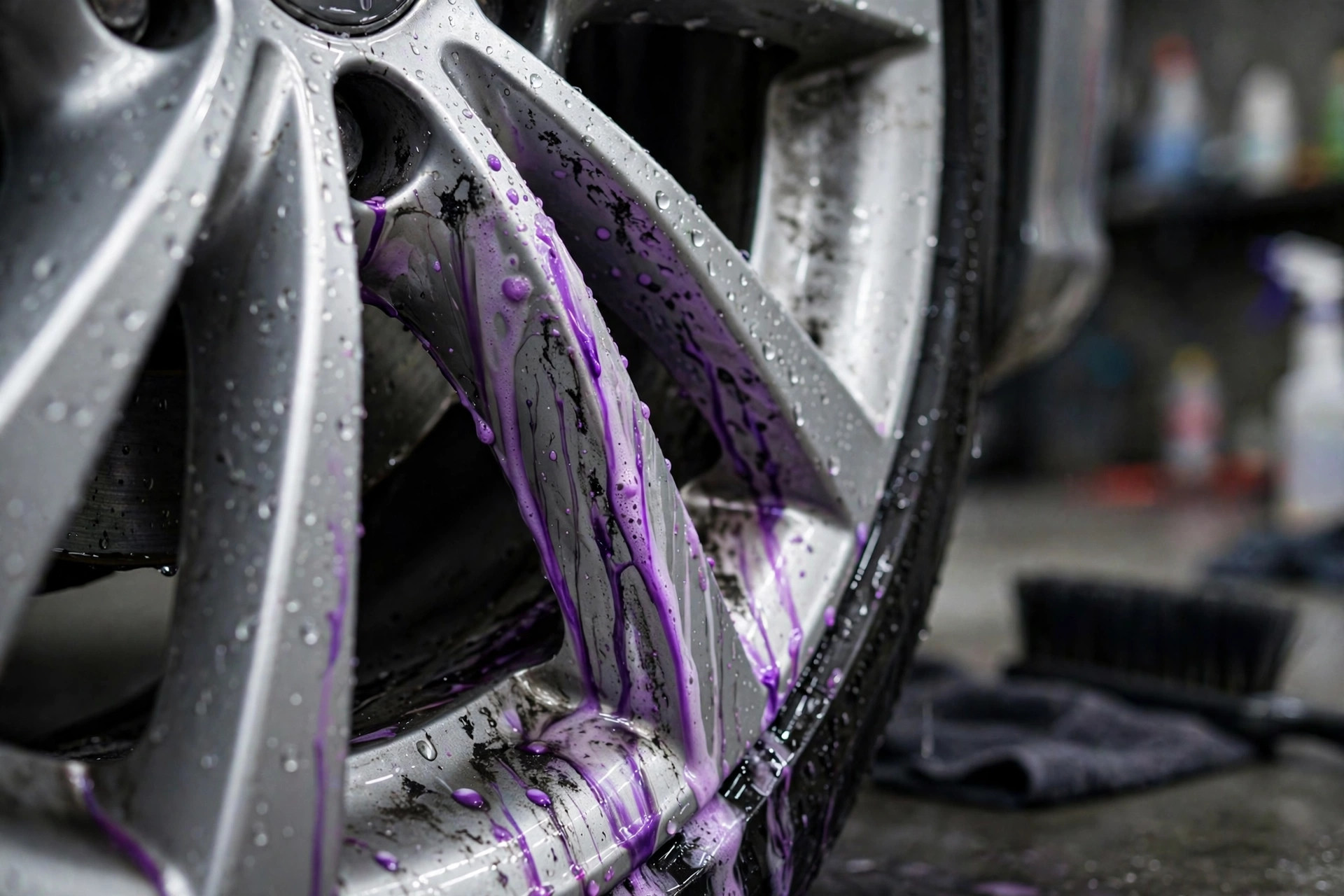
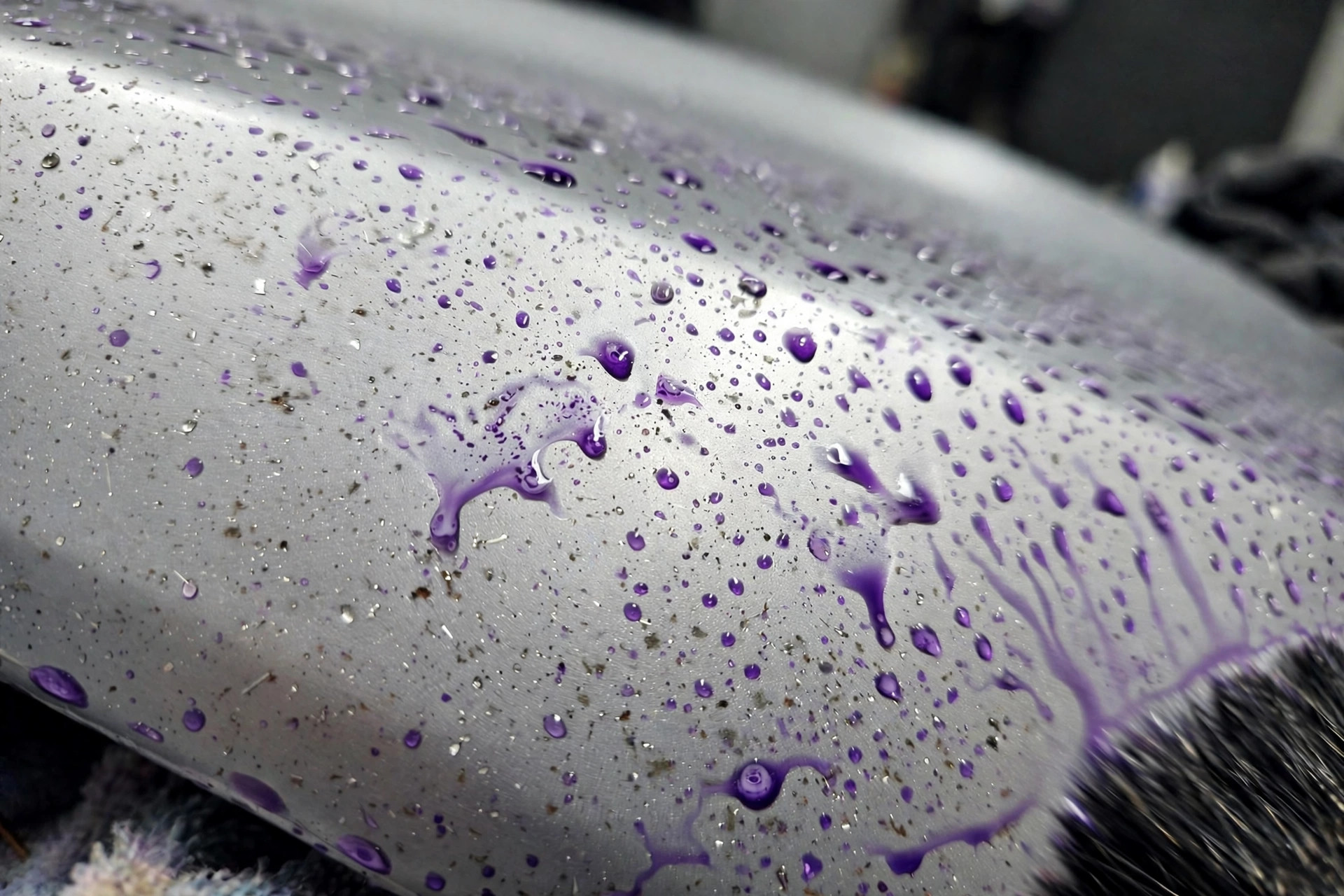
Iron remover is a chemical that reacts specifically with iron particles. Spray it on, let it dwell, and anywhere there's embedded iron, the product turns deep purple-red as it dissolves the particle. That color change — detailers call it “bleeding” — is the iron literally dissolving out of your paint.
It's the most satisfying part of a decontamination wash, and it's also diagnostic: heavy purple bleeding means heavy contamination. Wheels almost always bleed the most, because they live right next to the brakes.
Where Iron Hides
- Wheels and lower doors — closest to the brakes, always the worst.
- Rear bumper and trunk lid — turbulence deposits fallout behind the car as you drive.
- Hood and roof — industrial fallout settles from above.
- Everywhere, honestly — if the car is driven, it has iron in the paint.
Why It Matters Before Polishing and Coating
Iron decontamination isn't a standalone service for us — it's a standard step in our process, and the order is deliberate: decontamination wash → iron decontamination → clay bar → polish → coating.
Each step exists so the next one works better. Iron remover dissolves what soap can't touch. Clay then only has to deal with what's left, which means less dragging and less marring. Polishing works on truly clean paint instead of grinding contamination around. And ceramic coating bonds to bare clear coat — not to a layer of embedded iron rust.
Skip the iron step and you're polishing over contamination and coating over it. The coating's bond — and its lifespan — depends on what's underneath it. We covered exactly how much prep matters in how long ceramic coating really lasts.
Can You Do It Yourself?
Honest answer: iron remover is available to consumers and the process is straightforward — spray on, dwell, rinse. But it smells awful (like rotten eggs — that's the chemistry working), it needs proper dwell time without drying on the paint, and it should be followed by claying and protection. As part of a professional detail or coating prep, it's handled correctly in sequence with everything else.
The Bottom Line
Your paint is holding onto iron from every mile you drive, and no amount of washing removes it. Iron decontamination dissolves it chemically — you'll see the purple proof — and it's one of the reasons professional prep produces results a driveway wash can't touch.
Message us today if your paint feels gritty after washing, or if you’re considering a ceramic coating and want the prep done right from the start.
Vinnie's Auto Detailing and Ceramic Coating — Brookville, PA. ⭐100% Five Star Reviews⭐ | ☎️ 724-689-5482